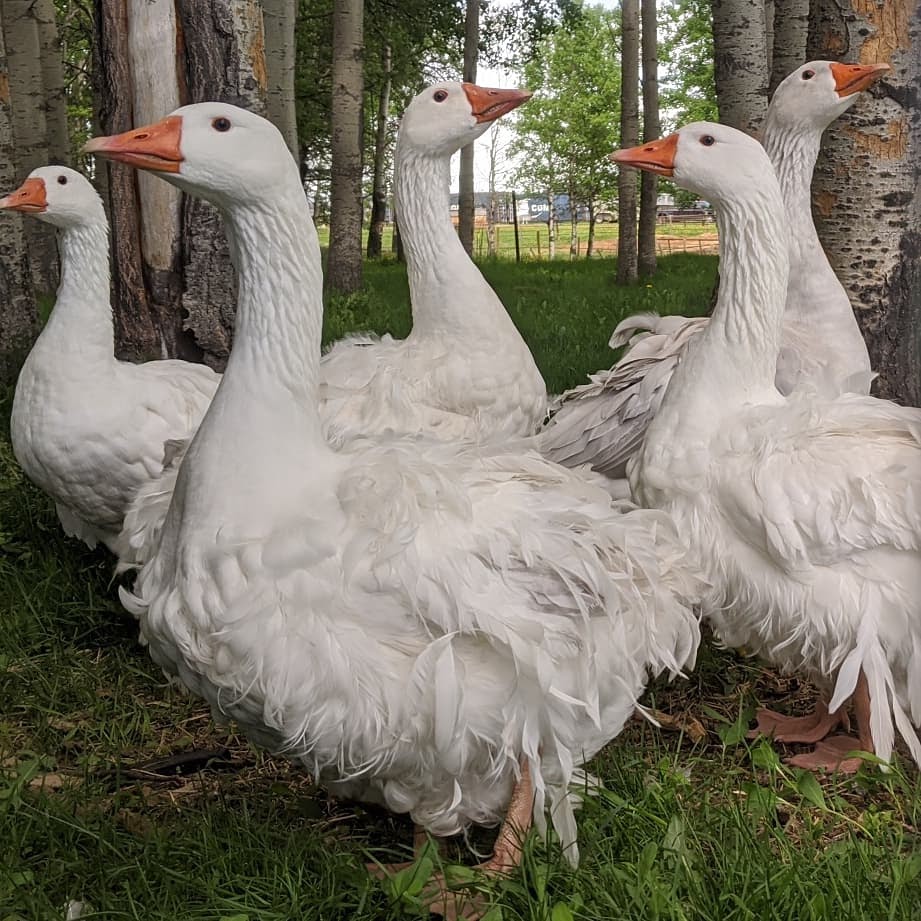
| Origin | Sevestopol along the Black Sea |
| Year Recognized | 1938 |
| Purpose | Ornamental, exhibition, pet |
| Eggs | 25-35 large white eggs per year |
| Varieties | White with blue eyes is the only recognized variety, although they can come in variety of shades of blue, grey, lavender, buff etc |
| Size | Medium Goose 4.5-6 kg Gander 5.7-7 kg |
| Availability | None available at this time. |
| Strengths | Quiet, calm, stunning birds with beautful flowing, curled feathers. Unable to fly. Good foragers. May come in smooth or curly chested. Winter hardy and easy to care for. Exceptional parents to goslings. |
| Challenges | Challenging to hatch. |
History
This medium sized ornamental bird is absolutely breathtaking to see in person. The long, curled feathers trail behind and they move like ballerinas. They are the equivalent of a “frizzle” chicken in the goose world. This bird has been prized for its beauty and ornamental qualities since it was first developed along the Danube river and Black Sea. There is nothing quite like it! They generally a gentle, peaceful bird with exceptional parenting skills with both genders nurturing the young, even if they did not hatch them themselves.
Our Stock
We began raising Sebbies in 2018. We have a large flock of colour carriers including colour carrying pure white, blue and grey splash and solid grey. Our flock consists of both smooth and curly chested birds. The quality of feathers is best preserved when smooth x curly birds are mated. Much like “frazzle” chickens, breeding too much curly x curly can result in feather quality problems. We are very excited to be seeing some exciting colours popping up this year!
Why Sebatstopols
We began raising geese in 2015 and tried our hand at raising Toulouse and Roman Tufted. All geese are *awesome* and I am awe inspired watching their incredible social dynamics and parenting skills. After several years of raising the other breeds I fell deeply in love with the breathtaking grace, beauty and gentleness of the Sebs. I went all in on that breed in 2019 and have not looked back. They are such a passion for me and I love having a small army of beautiful small dragons.
How We Raise Them
I raise my birds in a fairly unconventional way. I free range a large colourful flock of both genders year round. I don’t handle or interfere with them much, allowing them to form close family bonds and live dynamic, full social lives. Geese form extremely close knit bonds, and while it is cute to bond closely with goslings, humans with jobs, school and social lives cannot replace another goose 24/7 when it comes to companionship. I feel imprinting the goslings on people does them a disservice in the long term. I have also found that goslings raised by their parents grow up to have a healthy respect for humans, not viewing them as a potential love interest or competition. This method works well for us as our geese don’t feel the need to show undue aggression or inappropriate breeding behaviours towards humans. There is no better role model for young goslings than a doting parent. For several years I tried incubating and hand raising goslings. I find that there is no way to replace Mother Nature when it comes to raising robust, viable goslings with life skills including foraging, social cues and bathing.
Our geese live out on a large pasture year round 24/7. I rely heavily on good livestock guardian dogs (my preference is Turkish Kangals) to keep predators at bay. I also use motion sensor lights to deter nocturnal predation. Our goose pasture is fenced with no climb mesh on all sides. We provide shelter in unheated fibreglass barns bedded with hemp straw. I find it easiest to clean for indoor loafing areas as it doesn’t mat. I don’t feed or water inside these buildings unless a broody mama is on a nest or has little ones at foot. I find feeding and watering outside helps keep areas cleaner and well drained. Most of the year the geese opt to sleep outdoors in open air unless it is frigidly cold (-25 C or colder). I put large bedding packs of barley straw outdoors in winter to keep feet from getting too cold. I find this is important around water areas as well. When its below freezing I provide water in deep/tall 5 gallon heated pails so that the geese cannot submerge their bodies or feet. When temperatures are above freezing I provide multiple kiddie pools of fresh water and a very deep calf sled meant to be pulled by skidoo. This is one way to provide deep enough water for swimming/breeding but easy enough to dump and keep fresh.
I feed free choice texturized flock mix feed as my chickens are also free ranging. I haven’t had an issue with birds overeating or becoming obese as I have such a large area and they are very active and inquisitive. Their intake is much reduced in the summer months as their first choice is to graze and they take advantage of the grass as soon as it is up in the spring. I provide second cut dairy quality alfalfa during the winter months. Sprouted barley fodder grown at home is a nice way to supplement greens or look for pea sprouts in the grocery store.
In very early spring breeding season kicks off. The ganders will get rowdy and more vocal. As females are bred and become broody they will claim one of several small sheltered nesting areas and sit. Sometimes they will share a nest with another mama. Geese are exceptional at co-parenting and everyone dotes on new babies. They will happily accept new additions even if they didn’t hatch them themselves.
Availability
We do not sell goslings nor do we keep a waitlist. We do not ship birds across country. We are allowing all goslings to be raised by their parents this year and waiting to see them feather out prior to offering for sale. Mature breeding stock may be available in the fall. We will post available animals on our Facebook page.
 Ravenwood Ranch